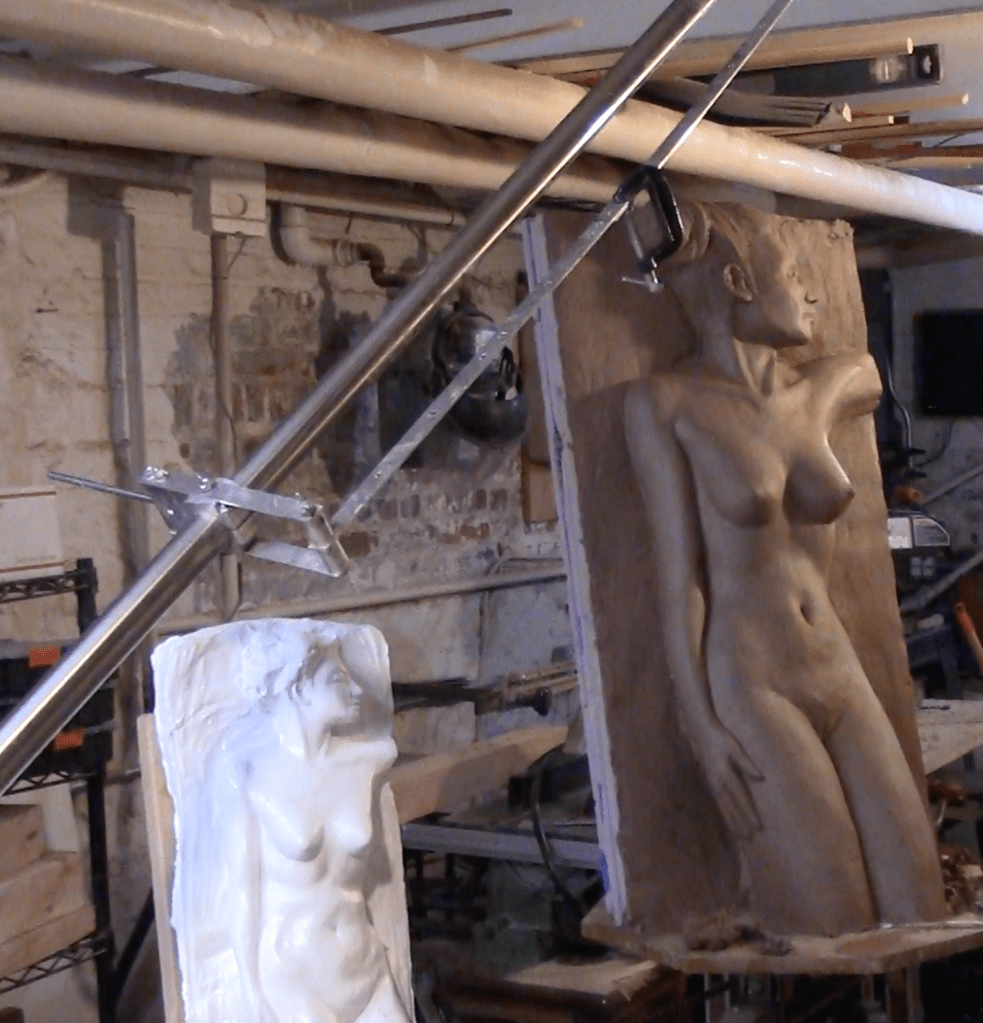
Finally, the model is complete. Actually, the full-size model has been complete for while but now there’s a video to go with it so I can do this post. It’s all hammer and chisel from here on out.
In the last episode we saw the construction of the full-size armature from the small scale original using the enlarging machine. In this episode we see all the rest of the steps: the armature covered in clay, the full-size clay tuned up and refined, the clay molded in plaster, the mold filled, and finally, and the finished full-size model released from the waste mold. Whew.
I counted my changes of clothes in the video and it looks like the whole thing is spread over five days, assuming I never just slept on a pile of plaster chips and kept going the next day. Everything takes longer than one imagines. I was guessing two or three days.
There was a ton of video, but it condensed down nicely into a reasonable length YouTube. Fortunately, many things that would be unbearably tedious in real time look great when you speed them up. It’s like claymation.
This was a new experience for me. I’ve never used the enlarging machine before and in fact, never even seen one, let alone seen one used. So my knowledge until now was all pretty theoretical. That said, nothing about the experience wasn’t very surprising.
One caveat for the viewer is that my use of the machine is fairly loose. My original is really just a sketch to get the overall form and make sure everything is in the right place, so I was free to take liberties with the result. If the clay was in the right place to an eight of an inch or a quarter of an inch, good enough.
I think that may be a non-typical use. Historically, these machines were often used to achieve a high degree of accuracy and indeed that is a common use of them today. I think one could achieve accuracy down to 1/32″ pretty easily. Working to that level of accuracy would be in order when the nominal artist wants to use either assistants or an outside service to do the enlarging. On the other hand, if you’re doing all phases of the work yourself, exquisite accuracy isn’t necessarily required and might not even be desirable. For my money, the ability to make a miniature that accurately captures what one wants to do full size is a high-order still all by itself. I basically enlarged the model and then reworked it full size.
That said, I’m confident that the machine could achieve more or less perfect accuracy.
 Sculpture Tech