I recently discovered a great new way to set the studio on fire. It was a complete surprise. If I ever knew this could happen I’d completely forgotten until it happened to me.
I’m paranoid about fire. My former studio was gutted by fire about fifteen years ago.
The building that the studio was in had been cobbled together from three carriage houses and a six-family tenement structure. It was such crazy warren of rooms and halls that for a year after the fire the captain from the firehouse would occasionally show up in a hook and ladder truck with batch of trainees in tow to show them the kind of wacky structures they might encounter on the job.
It could have been the stage set for a public service video about fire hazards but happily, the one part of the building that had been redone with fire code Sheetrock was the studio where the fire started. I love that stuff–it saved us.
So I’m not careless with sparks. I use grinders only in the metalworking area where there is nothing that can burn.
Gotcha!
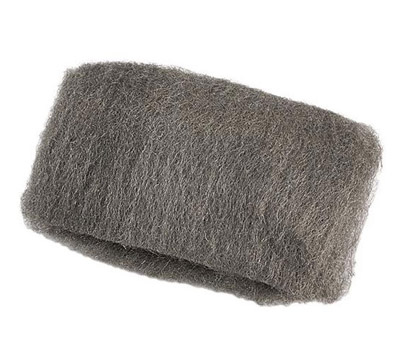
Who knew that steel wool is highly combustible? Not I. Turns out that it catches fire as easily as a dry cotton ball and unlike a cotton ball, it doesn’t smolder but flares up immediately and fiercely with no smoke or smell.
I had my nose to the bench grinder when I felt a wave of heat coming up at me and discovered a big wad steel wool in flames on the shelf below the grinder. The heat was the only reason I noticed it. It didn’t have any noticeable smell. Check out these pictures–not a wisp of smoke. (This is just a demo on the bench, not the surprise fire.)
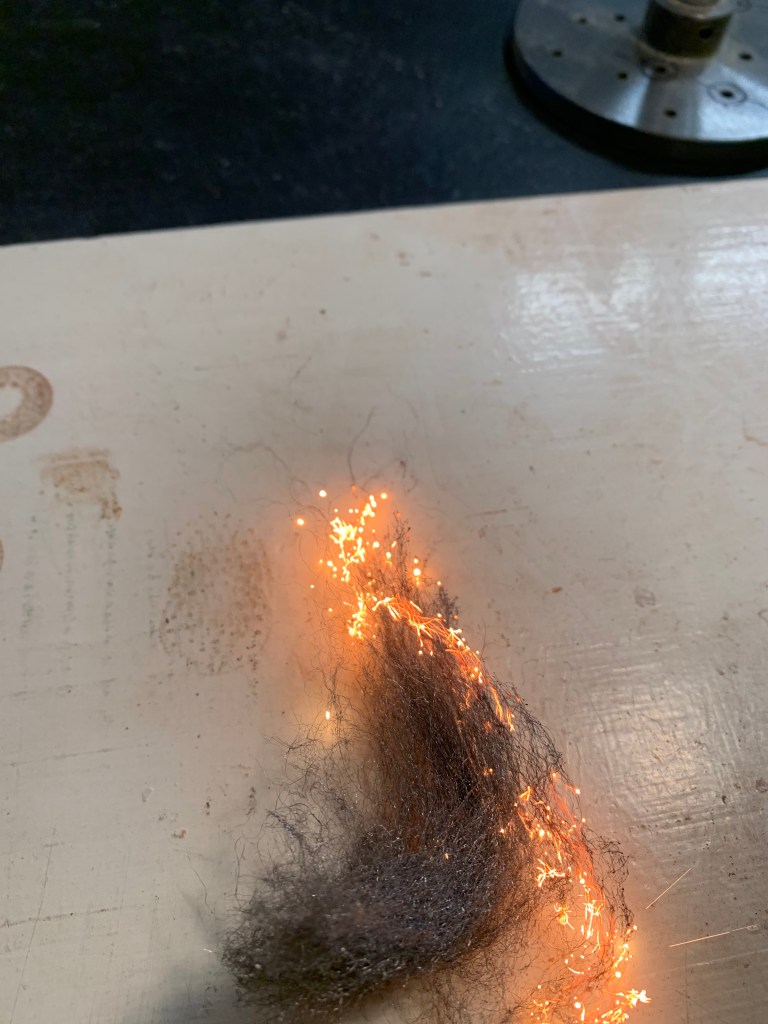
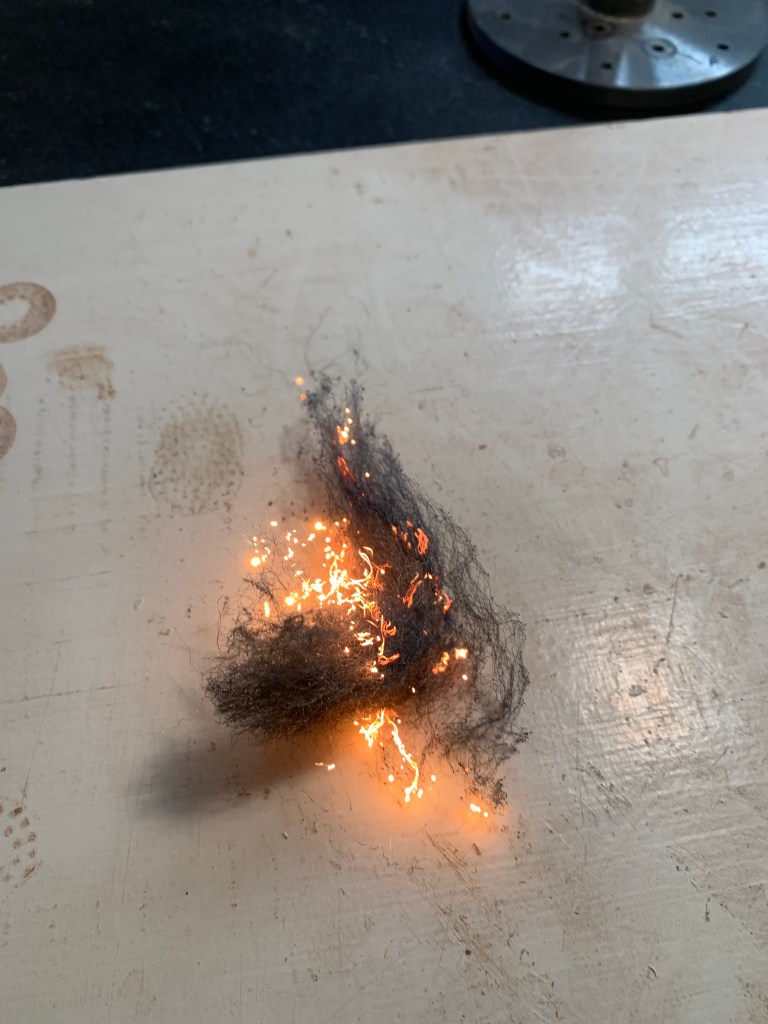
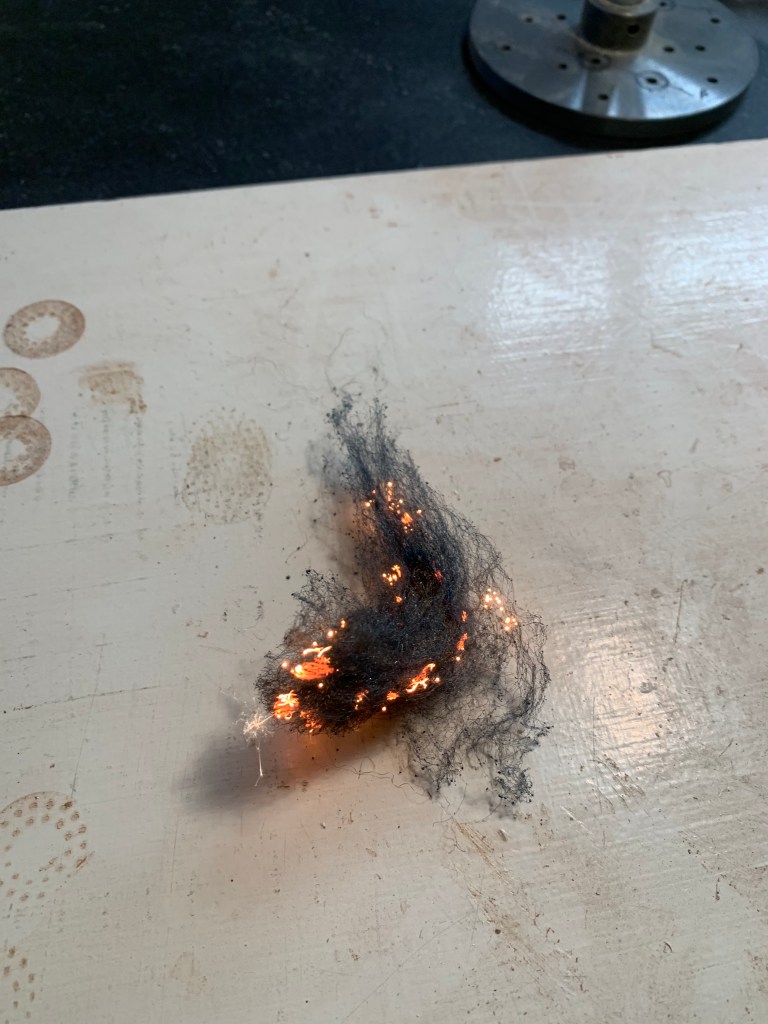
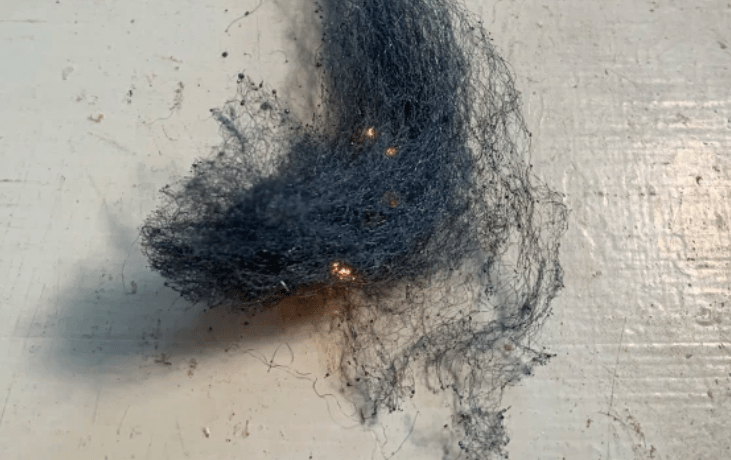
I touched off this fire with a butane lighter, but a single spark will do the same. The fire instantly races over it. I lit this piece at the end nearest the camera and snapped the first photo as fast as I could, so the fire probably went end-to-end in no more than a second or two.
The next two photos were taken within about five or six seconds. The big flame quickly burns the loose fuzz away and after that the burning spots crawl rapidly around the surface in all directions.
The last photo was perhaps fifteen or twenty seconds after ignition. As you can see it is still burning in several places, one of which is inside almost out of sight.
It’s interesting how it burns. The flame spreads quickly but it doesn’t form an organized flame that pulls in a stream of fresh air to keep itself burning. The first wave of flame burns off the fluff within seconds as it passes but the mass of wool doesn’t catch easily. As fresh air arrives where the fire has passed, tiny embers come to life and seem to crawl rapidly and randomly over the partly burned surface without flaring up into an open flame. Embers like the ones in the last picture will flare up at the slightest puff of air.
This was brand new #0000 fine steel wool right out of the bag. There are no solvents or oil on it. The only thing burning is metal.
Catching fire from grinder sparks was not a fluke. The spray of sparks from the bench grinder ignited pieces like this within seconds every time, even from several feet away. I have since been reliably informed that survivalists value steel wool because a spark from a flint and steel set will ignite it so easily.
I suspected that coarser steel wool probably wouldn’t be so combustible so I tried a hank of #16 medium coarse. The #0000 is almost downy but the #16 is like a wad of wires. It indeed behaved quite differently. The #16 burns where the butane lighter flame hits it but it doesn’t sustain the flame on its own for more than a couple of seconds. It goes out so quickly had to try a few times get a photo while it was still burning.
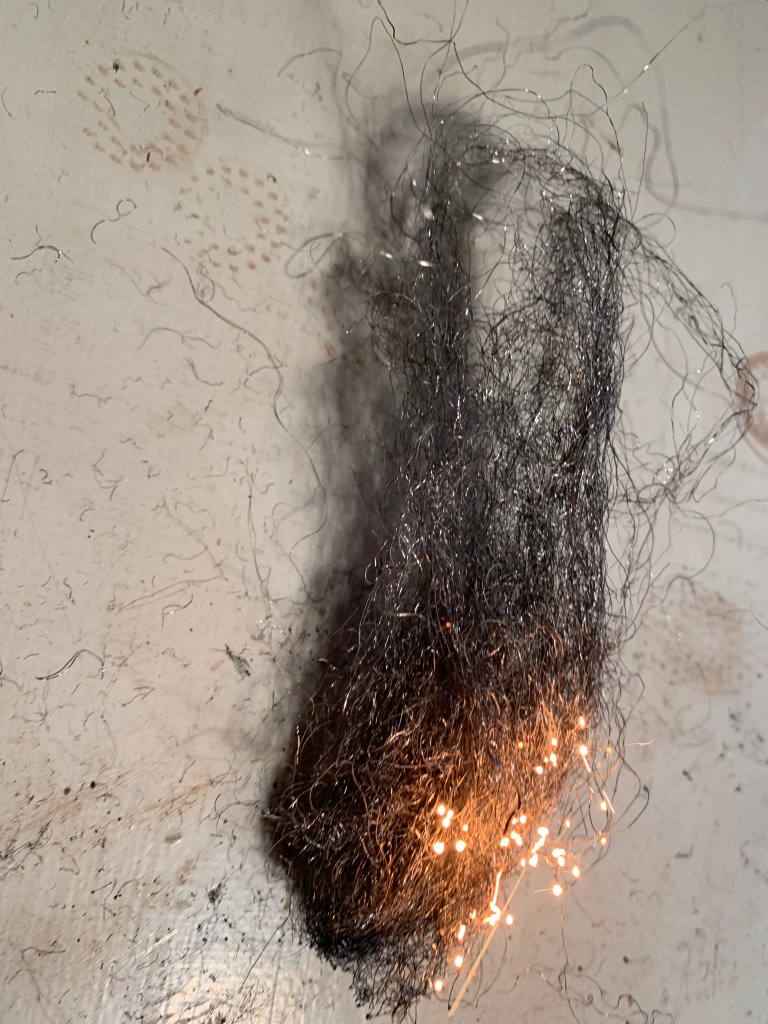

Sparks from the grinder will ignite individual wires but just as when ignited by the lighter they go out almost immediately.
Despite the rigorous nature of this scientific analysis, please don’t consider it to be a definitive proof that medium coarse steel wool safe around sparks. A new, clean piece of this particular grade and brand wouldn’t sustain a flame under these particular conditions but #16 wool cut by some other process might behave differently. Or some other manufacturer might call a slightly finer wool that does ignite “medium coarse.” Nor does this experiment address the possible effects of contaminants like oil, wax, or solvents. Therefore, err on the safe side and consider all steel wool combustible until proven otherwise.
 Sculpture Tech