We had to move the stones we cut to a new home the next day. They were easy to load because we had a hoist at the starting end but how do you get half-ton blocks of stone off at the other end without breaking the stone, the concrete driveway, or the tail of the truck? The ramp was only good for a few hundred pounds and it wouldn’t be easy or safe to skid or roll them down a ramp anyway.
With compact blocks like this you could just shove them off the back onto a pad a dirt landing, but this truck has a step and a trailer hitch in the way. It could definitely do damage.
Here’s how we did it! It worked very well on three big blocks and several small ones, but be super careful if you try something like this. Nobody should be anywhere near the target zone.

The stone is sitting on lengths of pipe so it’s easy to get it moving pretty fast, especially if you have Gabe to push it. The idea is that the moving stone will never really fall, but will do a series of pivots on the wooden blocks that will take it to the ground gently and carry it away from the step and trailer hitch.
The top of the wedge-shaped block is against the truck bed, higher than the bed but below the top of the rollers. The rollers are placed so that the first pipe to roll off the end of the bed will be approximately under the center of the moving block. Thus the weight of the stone will start to gently transfer to the wedge as the block starts to tip and the back still be riding on rollers.
As the weight transfers to the wedge, the wedge can only topple outward, carrying the stone forward and initially lifting it slightly, which keeps the weight on the trailing rollers.
The stone will be almost balanced on the wedge as it rolls forward because the stone landed on wedge as the pipe at the center of the block fell off the bed. After initially lifting the stone, further motion causes the point of the pivoting wedge to drop and accelerate the stone forward. We spaced the pipes so the last pipe would still be under the stone as it reaches the edge.
As the front of the wedge approaches horizontal, most of the stone’s weight is already on the tall wood block which also to topples, further carrying the block farther outward clear of the step and hitch. By the time the wedge falls off the step the block should be well clear of the step and moving rapidly away from the truck.
The tall block is narrow front to back, so as it lands face down on the plank with the back half of the stone on top of it and skidding forward, the leading edge of the stone will be at most a few inches above the plank. The stone should skid gently to a halt on the plywood and moving blanket pad. We were betting on whether it would land fully on the plywood or partly resting on the now horizontal block.
It went exactly as planned on each drop and the blocks ended up sitting neatly flat on the plank.
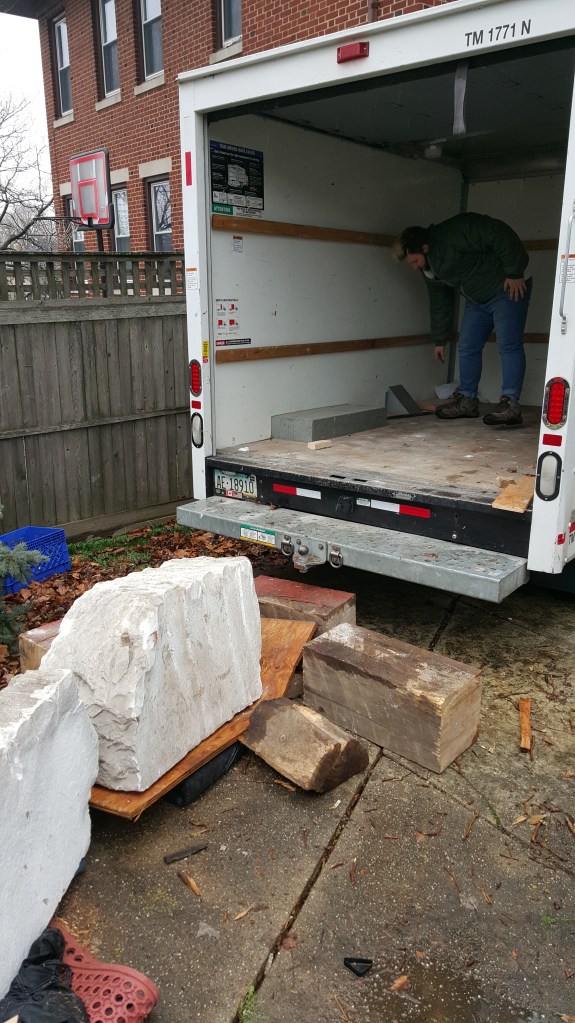
The sketchy part of this wasn’t the drop–we stayed way back for that. Getting a thousand pounds of stone off a springy pad safely was actually harder.
 Sculpture Tech